Why SEO Doesn’t Produce Overnight Results
One of the most common questions we receive from both prospective and active clients is: “When will my website start appearing on Google?” It’s an entirely valid concern. You’ve invested in SEO services, and understandably, you want to know when those results will arrive.
The honest answer is: SEO takes time. Not because something is broken, but because Google’s algorithm is deliberately designed to recognize a website’s trust and relevance incrementally. According to research by First Page Sage, the number one factor in Google’s 2025 algorithm is Consistent Publication of Satisfying Content, weighted at 23%—a signal built over time, not from a single piece of content.
This guide provides an honest, data-backed look at how long SEO typically takes to work, what affects its speed, and how you can track meaningful progress from the very first month.
A Realistic SEO Timeline: Month by Month
Here’s what you can realistically expect at each phase of an SEO campaign.
Months 1–2: Foundation and Crawling
In the early phase, the SEO team focuses on technical groundwork: website audits, keyword research, on-page optimization (meta titles, meta descriptions, heading structures), page speed improvements, and ensuring the site is properly mobile-friendly. Google begins crawling and indexing the changes made during this period.
At this stage, ranking changes may not yet be visible. However, building a strong technical foundation here is the key to accelerating growth in subsequent months. Page speed and mobile-friendliness contribute 3% and 5% to Google’s algorithm, respectively—small in weight, but essential prerequisites that can disproportionately penalize your site if neglected.
Months 3–4: Signals Begin to Form
Between months 3 and 4, you’ll typically begin seeing the first encouraging signs. Consistently published content starts getting indexed, certain keywords begin appearing on pages 2–3 of Google, and organic traffic gradually climbs. This is the phase where engagement signals (time on page, bounce rate) and content freshness start being factored into the algorithm.
According to First Page Sage data, pages updated at least once per year gain an average of 4.6 positions in the SERPs compared to those left untouched. This underscores that consistent content refreshes have a measurable impact even in the early stages of an SEO campaign.
Months 5–6: Meaningful Improvement
This is the inflection point where most clients start feeling a real difference. Targeted keywords begin breaking into Google’s first page, especially for low-to-medium competition terms. The 4–6 month range is broadly recognized as the window where SEO begins to deliver measurable return on investment for most businesses.
Months 7–12: Compounding Growth
At this stage, SEO results become compounding—the more quality content indexed, the greater your domain authority, and the easier it becomes for new keywords to rank. Businesses that consistently run SEO through year one typically end up with significantly stronger organic foundations than competitors who delayed or stopped halfway.
Factors That Influence SEO Speed
Not all websites progress at the same pace. Here are the key variables that determine how quickly SEO produces results:
1. Domain Age and Authority
Newer websites naturally take longer to earn Google’s trust. Domains that are over a year old—especially those with inbound links from other reputable sites—tend to rank faster because they’ve accumulated trust signals over time. In Google’s 2025 algorithm, backlinks rank third at a weight of 13%, while link distribution diversity (having multiple distinct pages with inbound links) contributes an additional 3%.
2. Keyword Competition Level
A keyword like “web development services” is far more competitive than “affordable web design for small businesses in Bekasi.” The more specific and localized your target keywords, the faster results can appear. The smart strategy involves building niche expertise—dominating a specific topic thoroughly before competing on broader, higher-volume keywords. Niche expertise itself carries a 13% weight in Google’s 2025 algorithm, equal to backlinks.
3. Content Quality and Consistency
Google rewards content published consistently that genuinely satisfies user search intent. Based on Q1 2025 algorithm data from First Page Sage, Consistent Publication of Satisfying Content is the single largest ranking factor at 23%. Thin or mass-produced content is no longer effective in today’s AI-dominated search landscape—SEO experts now say “average is the new bad,” reflecting the rising bar for content quality in a world where AI can generate decent content at scale.
4. Backlink Profile
Links from relevant, authoritative external websites remain one of the strongest trust signals for Google. The more diverse the distribution of pages on your website that have inbound backlinks, the greater your overall ranking ability. Quality and topical relevance matter far more than raw volume—a handful of links from highly relevant domains outweigh dozens from unrelated ones.
Metrics You Can Track from Month One
Even before ranking results become significant, certain metrics can indicate that your SEO work is moving in the right direction:
| Metric | Monitoring Tool | What to Look For |
|---|---|---|
| Google Search impressions | Google Search Console | Consistent upward trend over time |
| Indexed pages | Google Search Console | All key pages successfully indexed |
| Core Web Vitals | Google PageSpeed Insights | “Good” scores across all metrics |
| Keyword positions (11–50) | Ahrefs / SEMrush | Candidates ready to break into page 1 |
| Organic traffic | Google Analytics | Baseline for measuring future growth |
These metrics provide a clear picture of your website’s technical health and growth trajectory—long before you see a major traffic spike. A rising impression count in Search Console, for instance, is an early signal that Google is recognizing and surfacing your content.
SEO vs Google Ads: Which Is Better for Your Business?
This is one of the most frequently asked comparisons in digital marketing. Both channels have distinct strengths and limitations:
| Aspect | SEO | Google Ads |
|---|---|---|
| Long-term cost | Lower after initial investment | Requires continuous spend |
| Speed to results | 3–6 months | Visible within days |
| User trust | Higher (organic results) | Lower (perceived as advertising) |
| Sustainability | Compounds over time | Stops when budget runs out |
| Best suited for | Long-term sustainable growth | Urgent or seasonal promotions |
The ideal approach for businesses starting out: use Google Ads for immediate traffic while building SEO in parallel. Once SEO consistently delivers results, ad budgets can be strategically reduced or reallocated to other growth initiatives.
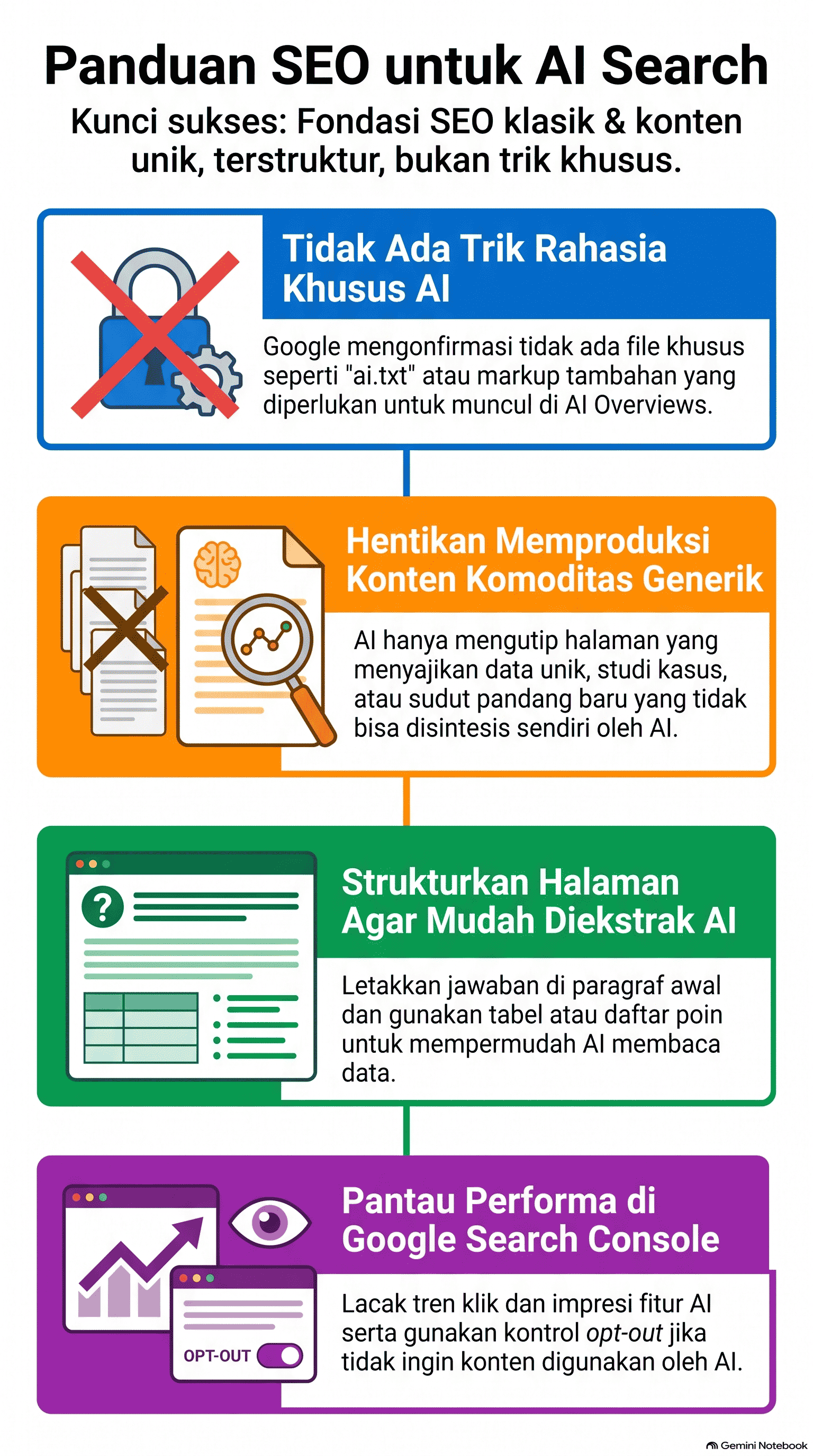
It’s also worth noting that according to WordStream, AI Overviews results in Google overlap approximately 86% in domain with traditional organic search results. This means building domain authority through SEO remains relevant and valuable even as AI-powered search continues to evolve.
How katili.dev Reports SEO Progress Transparently
We believe transparency is the cornerstone of a strong client relationship. That’s why every SEO package client at katili.dev receives a monthly report that includes:
- Keyword summary: current positions vs. the previous month for every target keyword
- Organic traffic data: upward/downward trends with causal analysis
- Published content: a complete list of articles or pages created in the reporting period
- Technical status: completed fixes and newly identified issues requiring attention
- Forward projections: realistic, data-driven targets for the next 30–60 days
We don’t promise page 1 rankings within a week. We promise a structured process, honest data, and sustainable growth.
Conclusion
SEO isn’t magic, and it’s not an investment whose results you’ll see overnight. But with the right strategy, consistent execution, and realistic expectations, SEO is one of the most valuable long-term digital assets your business can build.
If you start today, six months from now your website can have a strong, compounding organic foundation. If you wait, your competitors will be the ones capturing that traffic instead.
Interested in learning more about katili.dev’s SEO packages and how we can help your business grow organically? Contact us today for a free consultation.
References
- First Page Sage. (2025). The 2025 Google Algorithm Ranking Factors. https://firstpagesage.com/seo-blog/the-google-algorithm-ranking-factors/
- LinkBuilder.io. (2025). Top 11 Google Ranking Factors in 2025. https://linkbuilder.io/google-ranking-factors/
- WordStream. (2025). 7 Most Important SEO Ranking Factors for 2025. https://www.wordstream.com/blog/seo-ranking-factors-2025