The Traffic That "Disappears" Into AI Answers
Many website owners and marketers are seeing organic traffic decline even as overall search volume stays flat or grows. The cause isn't a traditional algorithm penalty—it's a shift in search behavior. AI Overviews, AI Mode, and chatbots like ChatGPT now answer questions directly on the results page or inside a chat window, often without requiring a single click. The question has shifted from "how do I rank #1" to "how does my content get cited as a source by AI".
Google's Official Position: No Special "AI File" or Optimization
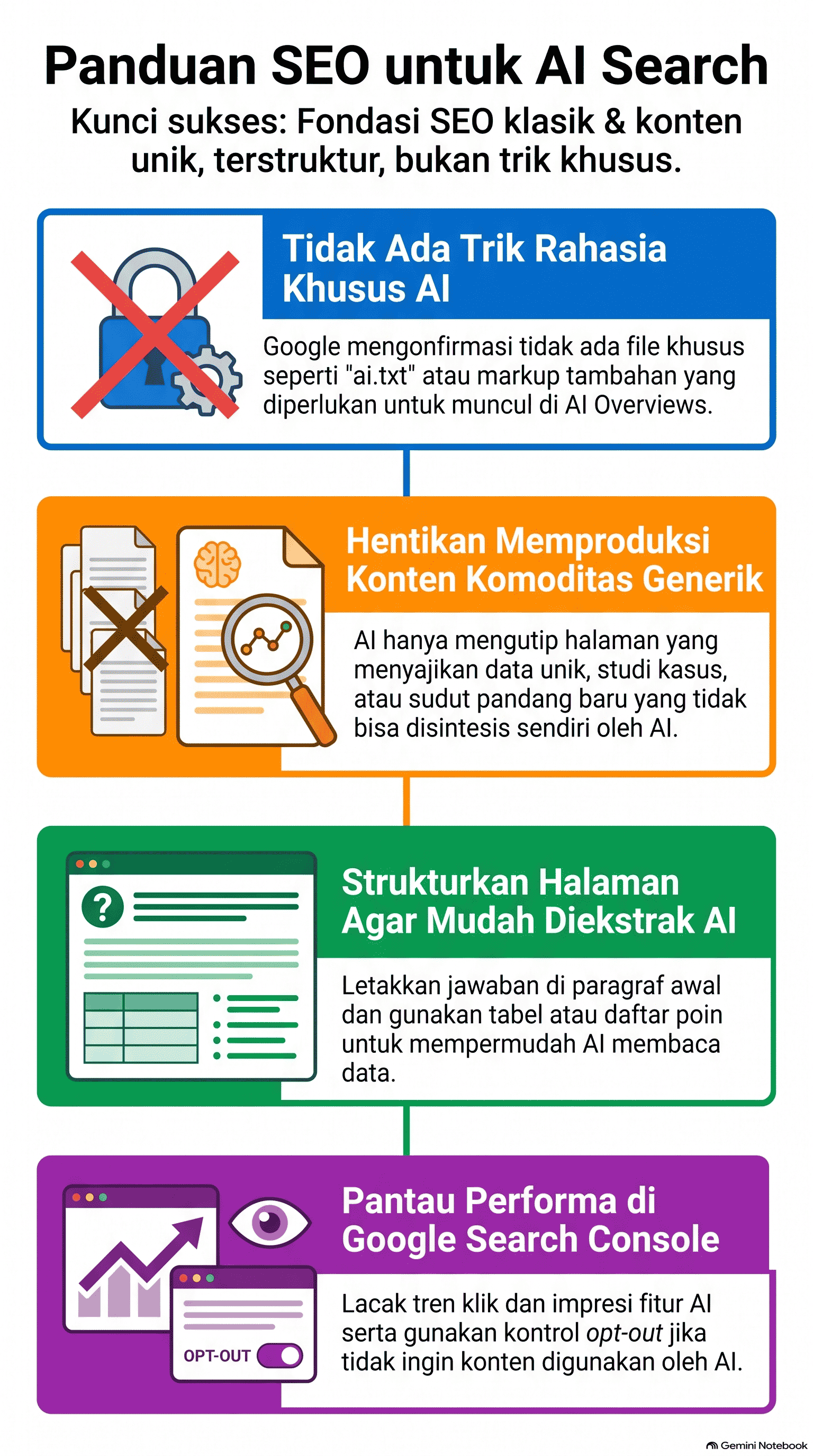
This is the most commonly misunderstood point. Google Search Central's documentation states explicitly that existing SEO best practices remain relevant for AI features such as AI Overviews and AI Mode, and there are no additional requirements or special optimizations needed to appear in them. Google also confirms that websites don't need to create new machine-readable files, "AI-specific" files, or any additional markup—including no special schema.org structured data—just to be eligible for these features.
The technical bar is simple: a page must already be indexed and eligible to appear in Google Search with a snippet, meeting the standard technical requirements for Search. There's no separate technical gate. In short, if you're searching for a magic "ai.txt" file or an "AI SEO" plugin, you're chasing something Google itself says isn't required.
The Old Fundamentals That Matter More Than Ever
Because there's no special shortcut, what's left is classic SEO fundamentals—and according to Google, these are exactly what still underpin AI features:
- Crawlability: make sure robots.txt, your CDN, and hosting infrastructure allow Googlebot to crawl important pages without obstruction.
- Internal linking: a clean internal link structure helps Google—and the AI models built on top of it—understand which pages matter and how topics connect.
- Content quality: helpful, reliable, people-first content remains the core foundation.
- Page experience: load speed, visual stability, and mobile usability still count.
- Structured data alignment: markup must match the visible text on the page.
Independent research from Backlinko covering hundreds of Google ranking factors reinforces the same pattern: quality content, backlinks, and technical SEO remain the top three drivers of visibility—not some new trick invented specifically for AI.
Why Commodity Content Will Never Get Cited
AI Overviews and AI Mode rely on a technique called "query fan-out"—breaking a single question into multiple related searches across subtopics and data sources before assembling a response. The models behind these features then look for supporting pages that genuinely add value beyond what the AI can already summarize on its own.
The implication is straightforward: if your page just repeats general definitions already available across thousands of other sources—with no unique data, first-hand experience, case study, or fresh perspective—the AI has no reason to cite you specifically, because that information is already "known" and can be summarized without pointing to any particular source. This aligns with Google's own guidance emphasizing unique, non-commodity content as a key factor for visibility in generative search features.
For marketers, this means auditing your entire content library: which pages genuinely offer new insight, and which are just keyword-volume filler.
Structuring Pages So AI Can Extract Them Easily
Because AI models need to pull self-contained pieces of information, page structure has an outsized effect on citation odds:
- Lead with the answer: state the core point in the opening paragraph, then elaborate. Don't bury the answer in paragraph fifteen.
- Descriptive headings: use H2/H3s that actually answer a specific sub-question (e.g. "How long does a hosting migration take?") rather than generic labels like "Discussion" or "More Details".
- Standalone claims: write sentences that still make sense when lifted out of their surrounding paragraph—this makes it easy for an AI model to cite them as one complete unit of information.
- Use lists and tables for structured data, since these formats are far easier to parse than dense, long-form paragraphs.
Here's a quick summary of the structural checklist:
| Page Element | Purpose for AI Search |
|---|---|
| Answer-first opening paragraph | Provides a summary that can be cited directly |
| Question-based headings | Maps content to specific user queries |
| Self-contained claim sentences | Enables clean extraction without losing context |
| Data in tables or lists | Speeds up parsing of structured information |
Google's New Control: The Opt-Out Toggle in Search Console
Google has also started rolling out new controls for website owners around AI features. Through Search Console, site owners can now choose whether their site should appear in and help ground responses within generative AI Search features like AI Overviews, AI Mode, or AI Overviews in Discover. Sites that opt out won't receive traffic or impressions from these generative AI features, though this control does not affect ranking in classic search results outside of those AI features. The feature was initially tested with a limited group before being rolled out to all websites worldwide.
Alongside the opt-out control, Google is also introducing new insights in Search Console covering impression data and information about which pages appear in AI responses, including by country.
Measuring AI Search Impact in Google Search Console
Since clicks and impressions from AI Overviews and AI Mode are counted as part of overall search data, here's a practical way to track them:
- Open the Performance report in Search Console and make sure you're viewing the "Web" search type—this is where traffic from AI features is recorded alongside classic search results.
- Compare click and impression trends over time for keywords that frequently trigger AI Overviews, and watch for CTR dropping while impressions stay stable—a typical sign that the answer is already being satisfied on the results page before users click through.
- Use the additional Search Console insights (in regions where they've rolled out) to see which specific pages appear in AI responses and their country breakdown.
- Combine this with Google Analytics to assess traffic quality: Google has noted that users who click through from results with AI Overviews tend to spend more time on the destination site, so dwell time and conversion metrics are still worth watching even if raw click volume declines.
Closing Thoughts
There's no official shortcut to "getting into AI Overviews." What remains is unfinished homework: make sure your site is easy to crawl, build a clear internal linking structure, stop producing commodity content, and structure pages so their answers can be extracted cleanly. That combination is what determines whether your content is worth citing—whether by Google or by any other AI assistant.
References
- Google Search Central, "AI features and your website" — https://developers.google.com/search/docs/appearance/ai-features
- Google Blog, "New opportunities, control and insights for website owners" — https://blog.google/products-and-platforms/products/search/new-controls-website-owners/
- Backlinko, "Google's 200 Ranking Factors: The Complete List" — https://backlinko.com/google-ranking-factors