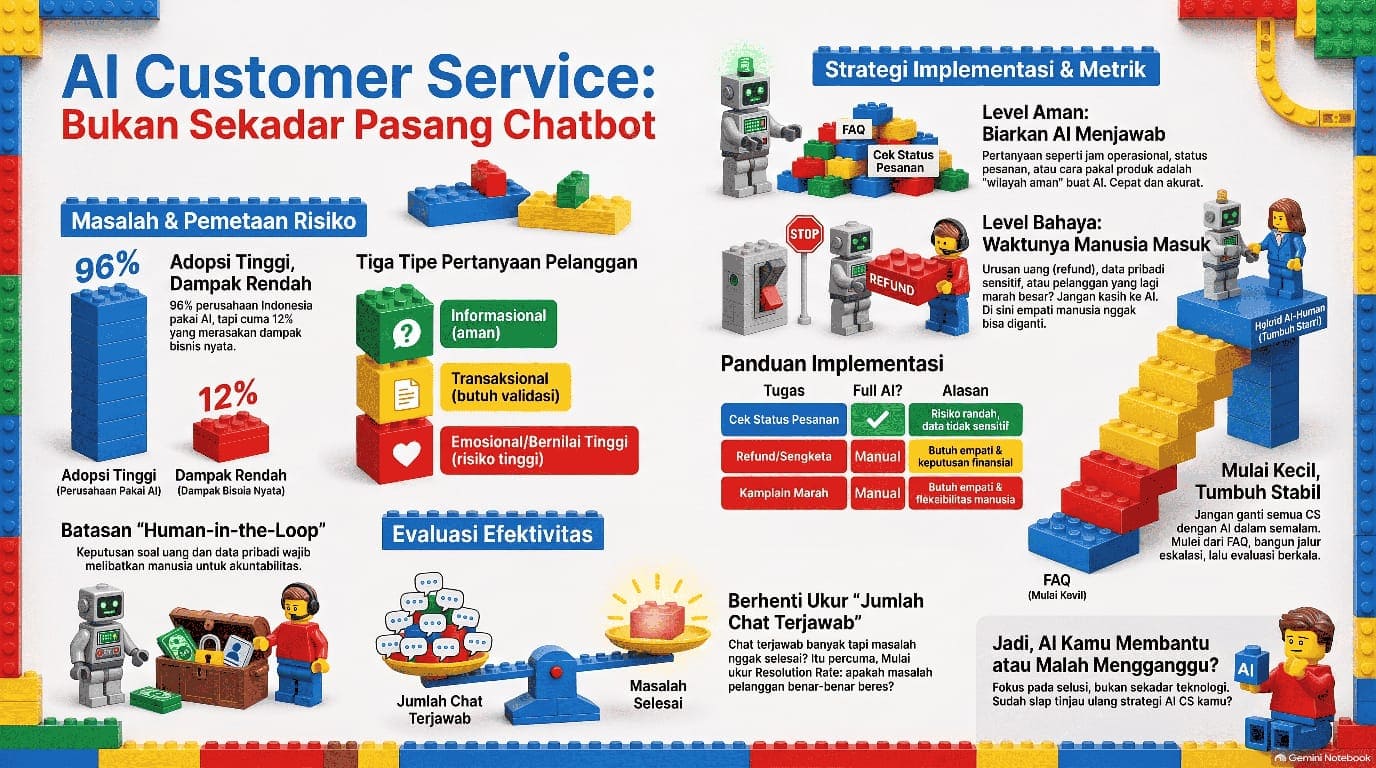
AI adoption in Indonesia is accelerating. An AWS study with Strand Partners, Unlocking Indonesia's AI Potential 2026, found that 40% of Indonesian companies have adopted AI, up from 25% a year earlier. Yet the same study shows that 56% of them are still at an early stage, and only 12% have integrated AI across the whole business. PwC research cited by Suara.com is blunter still: only around 12% of AI adoption in Indonesia produces tangible business impact.
In other words, many businesses are buying AI, but few are getting results. One rarely discussed cause is vendor selection. A contract signed in a hurry often leaves problems behind: running costs that balloon, systems that cannot be moved, and accuracy promises that are never proven. Here are 10 questions you should ask before you sign anything.
Part 1: Asset Ownership
1. Who owns the source code?
Make sure the contract explicitly states that code written for your project belongs to you, including access to the repository. If the vendor builds on an in-house framework, ask for licensing clarity: can you keep using it after the contract ends?
2. Who owns the data, embeddings and indexes?
Modern AI systems, especially those built on RAG (retrieval-augmented generation), store your documents as embeddings in a vector database. Those embeddings are derived from your data, so they should be yours. Also ask whether your data is used to train models or to serve other clients.
3. Who owns the agent configuration?
An AI agent is more than a model. Wikipedia sums it up as agent = model + harness: the language model is wrapped in a harness that handles tool dispatch, memory and state persistence, a sandbox, context management, and guardrails such as scoped permissions and approval tiers. The system prompts, tool definitions, rules and workflows are the operational brain of your system. If all of it lives only in the vendor's account, you are effectively renting.
Part 2: Transparent Running Costs
4. Who pays for tokens and servers?
The build fee is only the beginning. Every query to the model consumes tokens, and every month there are server, hosting and third-party service costs. Ask for a monthly estimate under several volume scenarios, and make it clear whether API usage is billed to your account or paid by the vendor and re-invoiced with a margin.
5. What do re-indexing and updates cost?
Whenever your documents change, embeddings need to be regenerated. Whenever a model provider releases a new version or retires an old one, prompts may need adjusting. Ask who handles this work and what it costs.
| Component | Key question | Ideal answer |
|---|---|---|
| API tokens | Whose account is billed? | Your own account |
| Server & database | Who manages it? | Stated in the contract |
| Re-indexing | How often, at what cost? | A written estimate |
| Model changes | Covered by maintenance? | Defined in the SLA |
Part 3: Technical Questions That Separate Serious Vendors
6. How do you manage context?
A model only "knows" what is placed in its context. A serious vendor can explain how they pick relevant documents, chunk text, keep conversation history, and stop sensitive information from ending up in the wrong place. An answer like "the AI figures it out on its own" is a bad sign.
7. How do you evaluate quality?
Ask to see their evaluation set: a collection of real questions with expected answers, rerun every time the system changes. Without measurable evaluation you will never know whether an update fixed the system or broke it. It also addresses the ROI measurement challenge highlighted in the AWS study.
Part 4: Red Flags to Watch For
8. Do they promise 100% accuracy?
Language models are probabilistic and can be wrong. An honest vendor talks about measured accuracy, how wrong answers are handled, and when a human must step in. A promise of 100% means they either do not understand the technology or are not being straight with you.
9. Will they explain the architecture, and do they have a rollback plan?
A vendor that refuses to explain its architecture on "trade secret" grounds makes it hard for you to judge the risk. Ask as well: if an update breaks something, how do you return to the previous version, and how long does it take? No rollback plan means every change is a gamble.
Part 5: The Exit Plan
10. What happens when the partnership ends?
Ask this at the start, not when the relationship has already soured. A good exit plan covers:
- Handover of code, raw data, embeddings and agent configuration in open formats.
- Architecture documentation and instructions to redeploy on other infrastructure.
- A transition period with agreed technical support.
- Deletion of your data from the vendor's systems, with written confirmation.
A simple test: if you could take all those assets, hand them to another team, and have the system running again within days, you are in a healthy negotiating position.
Conclusion
The AWS study names the biggest challenges for Indonesian companies as business strategy readiness, ROI measurement, talent development and AI governance. Choosing the right vendor touches all four at once. These ten questions will not guarantee a successful project, but they will separate vendors who only sell demos from partners ready to take responsibility until the system runs in production. Clear, written answers that make it into the contract are worth far more than an impressive pitch.