From Experiments to Real Results
Throughout this month we have looked at AI from many angles: that AI is fundamentally a pattern-recognition engine rather than a brain that truly "understands"; that AI feels smarter because it can now act, not just answer; and that the quality of its output depends heavily on the context we feed it. This closing article pulls all of that into a single working plan: a 90-day roadmap that is gradual, measurable, and realistic for your business.
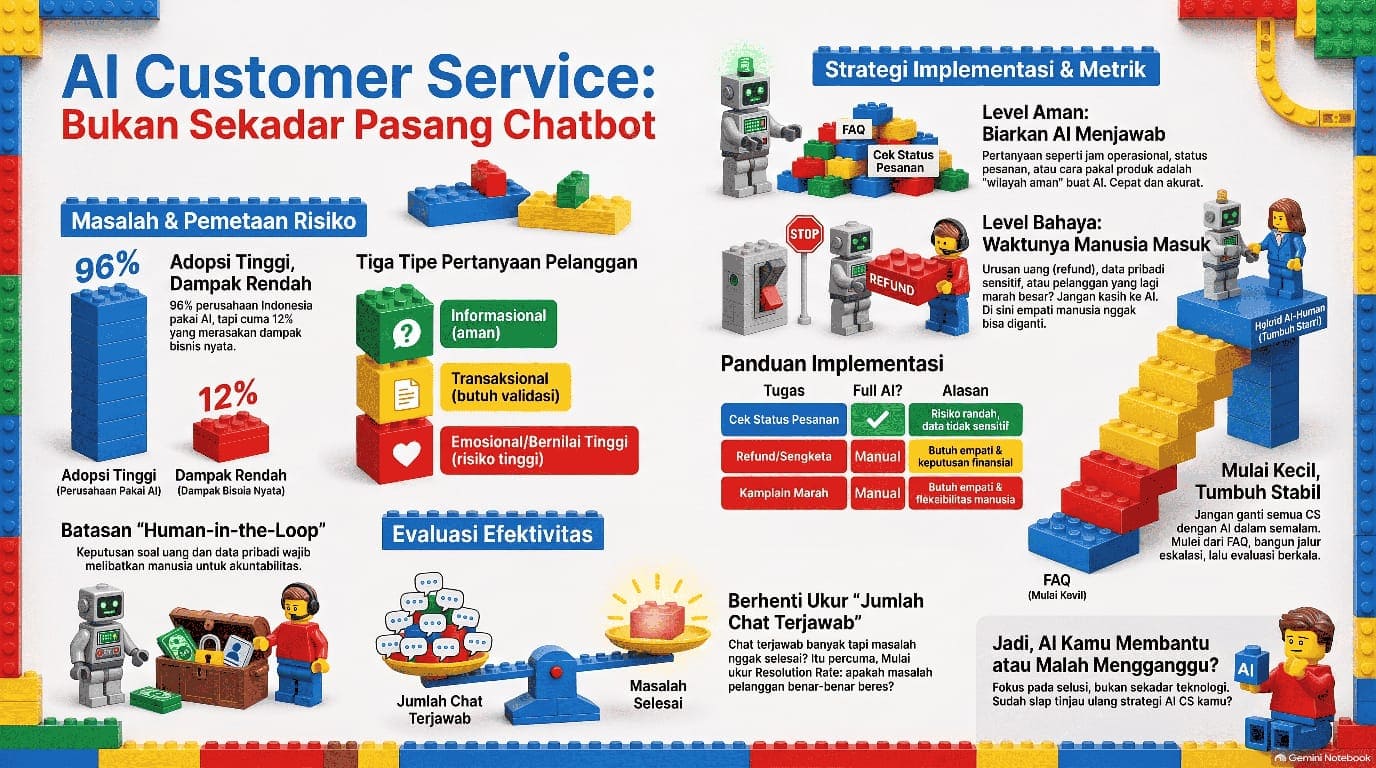
Why a roadmap? Recent data shows that enthusiasm alone is not enough. The Unlocking Indonesia's AI Potential 2026 study by AWS and Strand Partners, presented at AWS Summit Jakarta 2026, found that 40% of Indonesian companies have adopted AI (up from 25% a year earlier), and 75% of them report productivity gains. Yet 56% of those adopters are still in the early or exploratory stage, and only 12% have integrated AI across the business.
| Adoption stage (among adopting companies) | Share |
|---|---|
| Early / exploratory | 56% |
| Used in several business functions | 18% |
| Expanding across functions | 14% |
| Fully integrated | 12% |
Anthony Amni, Country Manager of AWS Indonesia, named the main challenges: business strategy readiness, measuring ROI, talent development, and AI governance. The roadmap below is designed to address all four head-on.
Days 1–30: Audit, Focus, and Clean Up Your Data
The first month is not about buying tools. It is about understanding your own business.
- Audit your processes. Map work that is repetitive, time-consuming, and text- or data-heavy: answering customer questions, compiling reports, reconciling orders, writing product descriptions. Record how many hours per week each one takes.
- Pick one high-impact use case. Not five. Choose one that happens often, follows fairly clear rules, and has an impact you can easily quantify. Remember that AI excels at recognising patterns, not at decisions that require empathy or moral judgment.
- Tidy up your data sources. AI is only as good as the context it receives. Gather FAQs, SOPs, product catalogues, and reply templates into one structured place. Remove outdated documents that contradict each other.
A principle from Anthropic's context engineering guide applies directly here: context is a finite resource. The more tokens you cram in, the worse the model gets at accurately recalling information (context rot). The goal is to find the smallest set of high-signal information, not to pile up every document you own.
Days 31–60: A Limited Pilot, Measured Honestly
Once your focus is clear, build a small version you can test.
- Measure a baseline first. Before AI goes in, record today's numbers: average response time, tickets per day, error rate, or cost per transaction. Without a baseline, "more productive" cannot be proven, which is exactly the ROI measurement problem the AWS study highlights.
- Build a limited pilot. Restrict it to one team, one channel, or one type of task. Keep a human reviewing AI output before it reaches customers.
- Define success metrics. For example: response time down 40%, answer accuracy above 90% on a manually checked sample, or a set number of work hours saved per week.
When writing instructions for the AI, follow Anthropic's advice: write a clear, well-organised system prompt that is neither as rigid as hardcoded logic nor so vague that it assumes shared understanding. Use a few representative examples instead of a long list of rules. If the AI uses tools, make sure each one has a clear purpose and they do not overlap.
Days 61–90: Gradual Production with Monitoring
A pilot that hits its metrics can move up, but still step by step.
- Roll out gradually. Extend it to a portion of customers or volume first, then increase slowly. Keep a quick path back to the manual process if something goes wrong.
- Monitor cost. AI model usage is typically billed per token or per API call. Track daily usage, set a budget cap, and watch for spikes.
- Monitor quality. Sample outputs regularly, log complaints, and re-measure the metrics you set during the pilot.
This matters most once your AI starts "acting": sending messages, changing data, or running commands. That ability to act is what makes AI feel intelligent, and it is also what most needs safeguards, monitoring, and human oversight.
Checklist Before Scaling
Before expanding AI into other functions, make sure every box is ticked:
Team readiness
- Every AI workflow has a clear owner
- The team understands AI's limits: it predicts patterns, it does not understand
- There is an SOP for reviewing and correcting AI output
Data security
- Sensitive customer data is not sent to AI services without a clear need
- API keys and tool permissions follow least privilege
- AI activity logs are stored and auditable
Compliance and governance
- Personal data use complies with applicable data protection regulations
- Customers know when they are interacting with AI
- There is an internal policy on which tasks may and may not be delegated to AI
When to Bring in a Technical Partner
You do not have to do every step alone. Consider a technical partner when:
- The use case needs integration with existing systems (website, database, WhatsApp, or an admin dashboard)
- Your team lacks the capacity to design context, prompts, and monitoring
- The pilot has proven itself but needs reliable infrastructure to go to production
This is where katili.dev can help: from building websites and web applications and providing stable hosting, to integrating AI into workflows such as content generators and WhatsApp message automation, all the way to an AI/ML co-researcher service for deeper research needs.
Closing Thoughts
Successful AI adoption rarely starts with a big project. It starts with one real problem, clean data, honest metrics, and the patience to scale gradually. With this 90-day roadmap, your business can move from the group that is still exploring to the group that actually feels the results.