Why This Matters Right Now
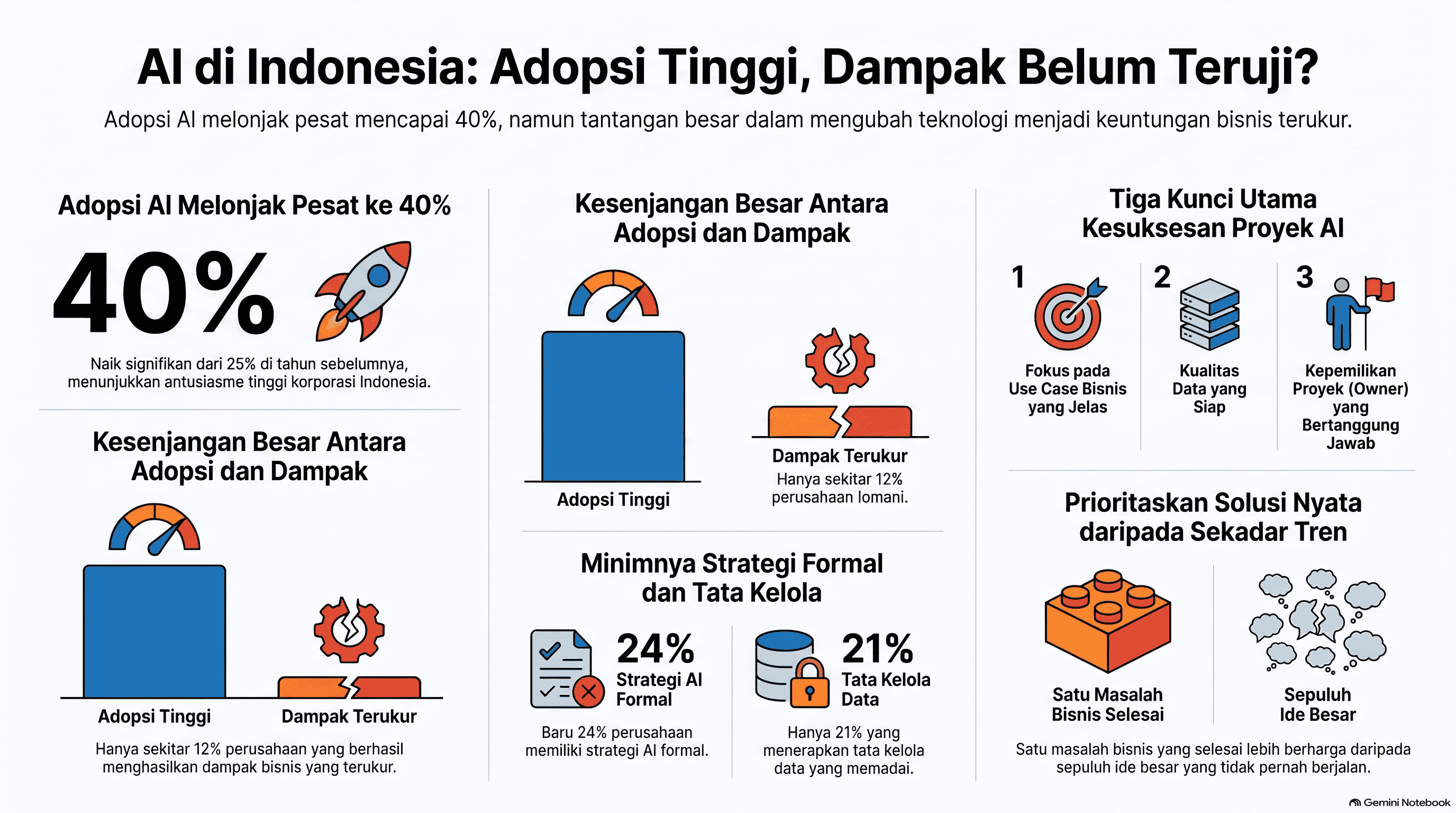
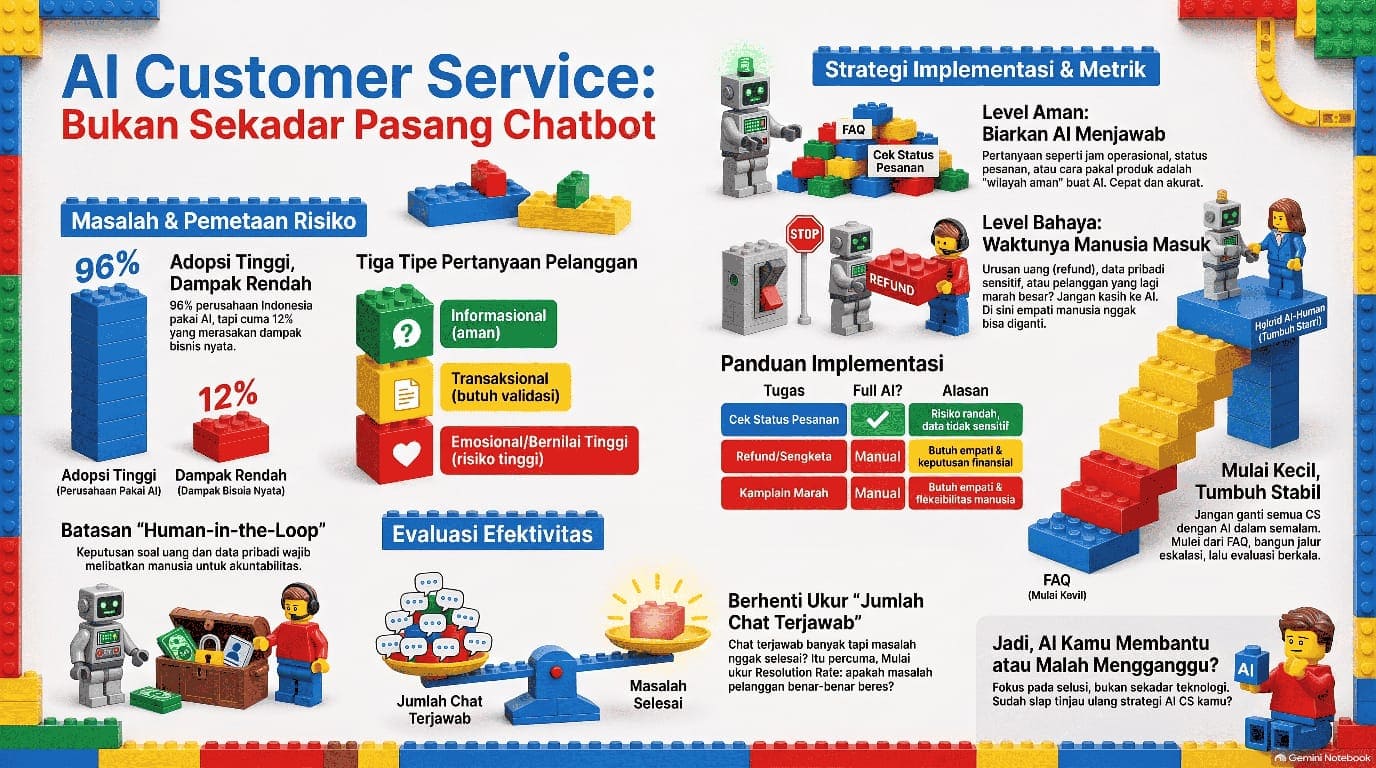
AI adoption among Indonesian businesses is climbing fast, but that doesn't mean it's going smoothly. AWS reports that roughly 40% of companies in Indonesia have adopted AI, yet only 24% have a formal AI strategy and just 21% have proper data governance in place. Meanwhile, a PwC study cited by Suara.com points to an even sharper gap: AI adoption in Indonesia has reached 96%, but only 12% of that adoption is actually generating measurable business impact.
These numbers matter a lot if you're considering an AI agent for customer service. Plenty of businesses rush to deploy a chatbot out of FOMO without a clear framework for what should be handed to AI and what must stay with a human. The result is often a chatbot that looks sophisticated on the surface but ends up frustrating customers underneath.
Three Types of Customer Questions, and Which Are Safe for AI
Before touching the technology, it helps to map out the kinds of questions that actually come in. Broadly, there are three categories:
1. Repetitive informational questions — order status, business hours, how-to instructions, return policy. This is the safest zone for AI because the answers are fixed and don't involve a judgment call that could hurt the customer if it's wrong.
2. Simple transactional requests — updating a shipping address, checking payment status, resetting a password. These can still be automated, but they need tighter identity verification since they touch account data.
3. Questions involving high-value decisions or strong emotion — product quality complaints, refund requests outside standard policy, payment disputes, or complaints laced with anger. This is the riskiest zone to hand over entirely to AI.
The practical rule of thumb: the bigger the financial consequence or the higher the emotional stakes, the stronger the case for bringing in a human from the start, not after the customer is already upset.
Why Human-in-the-Loop Is Non-Negotiable for Money and Personal Data
Modern AI agents have moved past simply answering — they can now take real actions, like processing refunds, updating account data, or executing commands through a backend system. That's exactly where the risk goes up. Once AI shifts from giving an answer to taking an action, the cost of a mistake shifts too: from a wrong piece of information to actual damage — money sent to the wrong place, customer data changed without proper authorization, or access granted to the wrong person.
For decisions involving money — refunds, subscription cancellations, changes to billing amounts — and decisions involving personal data — identity verification, sensitive information changes, account deletion — human-in-the-loop isn't an optional add-on, it's a baseline requirement. Not because AI can't technically handle it, but because accountability for high-stakes decisions still needs to sit with someone who can take responsibility and hold the full context of a customer's situation.
| Decision Type | Full-AI Allowed? | Reason |
|---|---|---|
| Checking order status | Yes | No financial or sensitive-data risk |
| Password reset with standard verification | Yes, with validation | Low risk if the verification procedure is strong |
| Refund outside policy | No | Involves money and case-by-case judgment |
| Sensitive account data changes | No | Involves privacy and misuse risk |
| High-emotion complaint escalation | No | Requires human empathy and flexibility |
Escalation Path: How an Agent Knows When to Stop
One piece of AI agent design that often gets overlooked is the stopping mechanism. A well-built AI agent typically operates in a loop: receive a request, analyze context, decide on an action, use available tools, then evaluate the result. A healthy escalation path inserts checkpoints throughout this loop, not just at the very end.
Some escalation triggers we typically design for clients:
Transaction value thresholds — if the amount involved crosses a certain limit, the conversation is automatically routed to a human agent.
Negative sentiment detection — if the customer's language shows rising frustration or anger, the AI stops and hands off the conversation.
Low answer confidence — if the AI isn't confident in its own answer, it's better to admit uncertainty than to guess.
Explicit customer request — if a customer asks to speak with a human, that request must be honored immediately, not deflected with another templated reply.
Scenarios outside trained cases — AI shouldn't try to improvise a solution for a situation it was never designed to handle.
Good escalation also hands off the full conversation context to the human agent, not just an empty ticket. Customers shouldn't have to repeat their story from scratch.
Common Mistake: Measuring Success by Chats Answered, Not Problems Solved
Many businesses measure the success of their AI customer service by the wrong metrics: number of chats answered, first response time, or containment rate, the percentage of chats resolved without escalation. The problem is these metrics can look great on paper while the customer's actual problem never gets solved.
A classic pattern: the AI replies quickly with a generic answer, the customer gives up asking further because they feel unheard, and the chat gets closed as resolved. The metric looks like a win, but the customer walked away with an unresolved problem, and is unlikely to come back.
More honest metrics include true resolution rate (whether the issue was actually fixed, verified through a follow-up or short survey), repeat contact rate (how many customers have to reach out again for the same issue), and post-interaction customer satisfaction, not just the raw volume of conversations AI handled.
The Phased Rollout We Usually Recommend
Rather than replacing an entire customer service team with AI overnight, a phased approach is far safer and more realistic, especially given how uneven AI governance still is across Indonesian businesses:
Start with pure informational FAQs — the safest zone, minimal downside if something goes wrong, and results show up quickly.
Add identity validation for light transactional requests — while continuously monitoring accuracy and customer satisfaction.
Build the escalation path before expanding AI's scope — don't widen what AI handles until the escalation route has been tested.
Run AI and humans in parallel for high-value cases — AI drafts a response or summary, but a human still decides and sends it.
Review regularly based on resolution rate, not volume — only expand automation coverage once the data shows consistent results.
This phased mindset lines up with a broader shift in how AI is perceived: AI feels genuinely intelligent today not because the underlying model suddenly got dramatically smarter, but because of its ability to act through tool integration and iterative workflows. That very ability to act is exactly why human oversight becomes more important, not less.
Closing Thoughts
AI agents for customer service were never meant to be all-or-nothing. The businesses that get this right are the ones who clearly separate what's safe for full automation, what still needs human oversight, and who build an escalation path that actually works, not just a rarely-used talk-to-a-human button. With only 24% of companies in Indonesia having a formal AI strategy, the most realistic path forward starts with a small, measurable scope, not a sweeping rollout that risks joining the pile of AI adoption that never translates into real impact.
References
Kompas Tekno, "AI Adoption in Indonesia Hits 40 Percent, AWS Reveals Many Companies Aren't Ready" — https://tekno.kompas.com/read/2026/08/07/13310077/adopsi-ai-di-indonesia-tembus-40-persen-aws-ungkap-banyak-perusahaan-belum-siap
Suara.com, "Business-Scale AI Adoption Still Low in Indonesia" — https://www.suara.com/bisnis/2026/04/20/140950/adopsi-ai-skala-bisnis-masih-rendah-di-indonesia
Katili Dev, "AI Feels Smart Because It Can Act, Not Just Think" — https://katili.dev/blog/ai-feels-smart-because-it-can-act-not-just-think