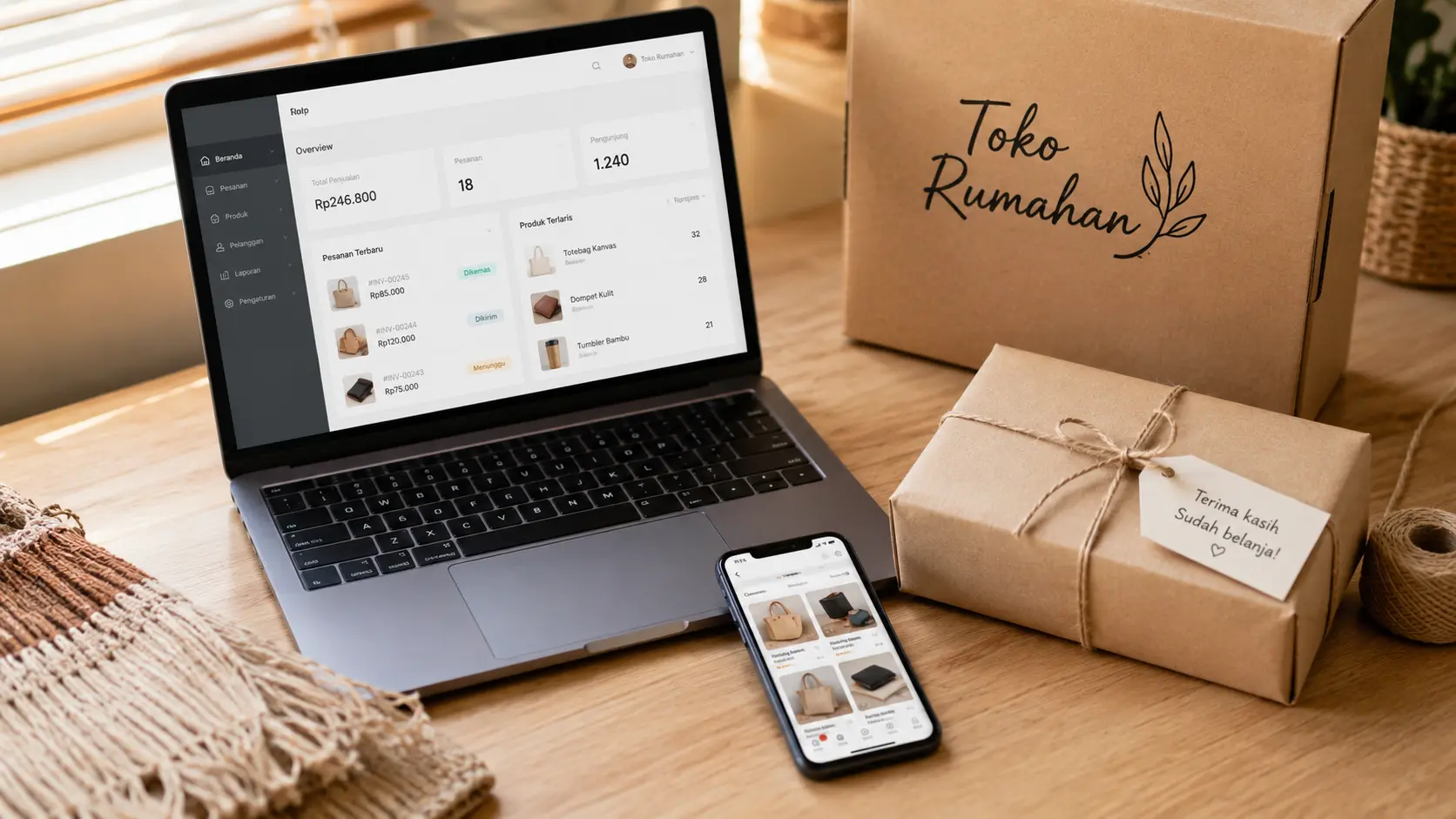
Marketplaces Are Huge, But Are They Safe for Your Business?
Many online sellers in Indonesia start their businesses on marketplaces such as Shopee or Tokopedia. The reason is obvious: the traffic already exists, payment systems are ready, and customers are familiar with shopping there.
This strategy works well in the beginning. However, problems start to appear when a business depends entirely on marketplaces.
Indonesia’s ecommerce market is extremely competitive today. According to Momentum Works data discussed by CNBC Indonesia, Shopee controlled around 40% of Indonesia’s ecommerce GMV in 2023, while Tokopedia held roughly 30%.
That means most online transactions in Indonesia happen within just a few large platforms.
On one hand, this proves the market is mature. On the other hand, small sellers become heavily dependent on platform policies.
If fees increase, algorithms change, or an account gets penalized, sales can drop immediately.
The Risks of Relying Too Much on Marketplaces
Marketplaces make selling easier, but they also create several long-term risks for sellers.
1. Increasing Fees and Commissions
Most marketplaces continue increasing service fees to improve profitability.
Sellers now face:
- Admin fees
- Free shipping program fees
- Advertising costs
- Affiliate commissions
- Promotional deductions
As a result, profit margins become thinner every year.
For example, a product sold for Rp100,000 with an initial 30% margin may end up with only 10–15% profit after platform deductions.
This situation forces many sellers into aggressive price wars just to stay competitive.
2. Platform Rules Can Change Anytime
Marketplaces fully control their ecosystems.
Today your product may appear on the first page. Tomorrow it could disappear because the algorithm changes.
The TikTok Shop regulation issue in Indonesia also showed how platform decisions and government policies can directly impact online businesses.
When sellers depend entirely on one platform, they lose control over their own business growth.
3. Extreme Price Competition
Marketplaces make it very easy for customers to compare prices.
As a result, sellers often compete based on the cheapest price instead of product quality or brand value.
This is dangerous for long-term sustainability.
When your business is only known as “the cheapest option,” customers have no real reason to stay loyal.
The moment another seller offers a slightly lower price, customers switch immediately.
Why Having Your Own Online Store Is More Profitable
Owning your own ecommerce website gives you more control over your business.
This does not mean marketplaces should be abandoned. Instead, your own online store helps build a more stable and sustainable business.
1. Stronger Brand Control
Inside marketplaces, most stores look similar.
It is difficult to create a truly unique brand identity.
With your own website, you control:
- Store design
- Brand colors
- Customer experience
- Promotions
- Product presentation
- Brand storytelling
A strong brand helps customers remember and trust your business.
2. You Own Customer Data
This is one of the biggest advantages.
Inside marketplaces, customer data belongs mostly to the platform.
You cannot freely build direct relationships with buyers.
With your own website, you can collect:
| Data | Benefits |
|---|---|
| Customer emails | Email marketing |
| WhatsApp numbers | Promotional broadcasts |
| Purchase history | Retargeting campaigns |
| Favorite products | Personalized offers |
Owning customer data significantly reduces long-term marketing costs.
You no longer need to rely entirely on marketplace ads to bring back repeat buyers.
3. Better Profit Margins
Because platform deductions are lower, profit margins are usually healthier.
Of course, a website still requires hosting and domain costs, but these expenses are often much cheaper than marketplace commissions over time.
Sellers also gain more flexibility in pricing strategies without being trapped in endless discount wars.
The Best Strategy: Hybrid Instead of Choosing One
One of the biggest mistakes is thinking marketplaces and websites must replace each other.
In reality, the best strategy combines both.
Use marketplaces for:
- Acquiring new customers
- Reaching mass audiences
- Product validation
- Increasing brand awareness
Then use your own website for:
- Customer retention
- Repeat orders
- Membership systems
- Product bundling
- Upselling
- Long-term branding
This hybrid model is already used by many successful brands.
Marketplaces function as acquisition channels, while websites become the main business asset.
For example, after customers receive products purchased from marketplaces, sellers can direct them to the official website for:
- Member vouchers
- Repeat-order discounts
- Loyalty programs
- Exclusive products
Over time, loyal customers gradually move into your own ecosystem.
How to Start Your Own Online Store on a Budget
Many sellers assume building a website is expensive.
In reality, ecommerce websites are now far more affordable than they were a few years ago.
Here are simple steps to get started.
1. Use Affordable Hosting and Domains
For beginners, shared hosting is usually enough.
A domain and hosting package can start from just a relatively small annual budget.
2. Choose an Easy Platform
Popular options include:
| Platform | Best For |
|---|---|
| WordPress + WooCommerce | Flexible and affordable |
| Shopify | Easy setup |
| Custom Laravel Website | More scalable businesses |
For most small businesses, WordPress + WooCommerce is already sufficient.
3. Prioritize Mobile Experience
Most Indonesian customers shop using smartphones.
Your website should:
- Load quickly
- Be mobile friendly
- Have simple checkout
- Support WhatsApp integration
- Support local payment gateways
4. Build Customer Databases Early
Do not focus only on the first sale.
Start collecting customer data from the beginning for long-term marketing strategies.
Examples include:
- Newsletters
- WhatsApp opt-ins
- Member systems
- Loyalty programs
Conclusion
Marketplaces remain important in Indonesia’s ecommerce ecosystem. With Shopee controlling around 40% and Tokopedia around 30% of Indonesia’s ecommerce GMV in 2023, marketplaces are still major traffic sources for online sellers.
However, depending entirely on marketplaces is risky.
Fees can increase, rules can change, and price competition continues becoming more aggressive.
That is why building your own online store is essential for long-term business growth.
A website is not just a sales channel — it is a digital asset you truly own.
The best approach is not abandoning marketplaces, but using marketplaces for customer acquisition while using your website for retention and brand building.
With a hybrid strategy, online businesses can grow more sustainably, maintain healthier profit margins, and reduce dependency on third-party platforms.
References
- CNBC Indonesia — Indonesia ecommerce competition and 2023 GMV data
- Cube Asia — Analysis of Tokopedia and Southeast Asian ecommerce growth
- INDEF — Study on the role of digital platforms in Indonesian MSME development