The First Dilemma Every New Business Owner Faces
When taking a business online for the first time, most owners run into the same question: "Do I need a landing page or a full website?" The two sound similar, but they serve fundamentally different purposes. Making the wrong choice can waste your budget — or worse, attract visitors who never convert into actual customers.
This article breaks down the core differences between the two, backs it up with real data, and helps you decide which approach fits your business situation right now.
What Is a Landing Page?
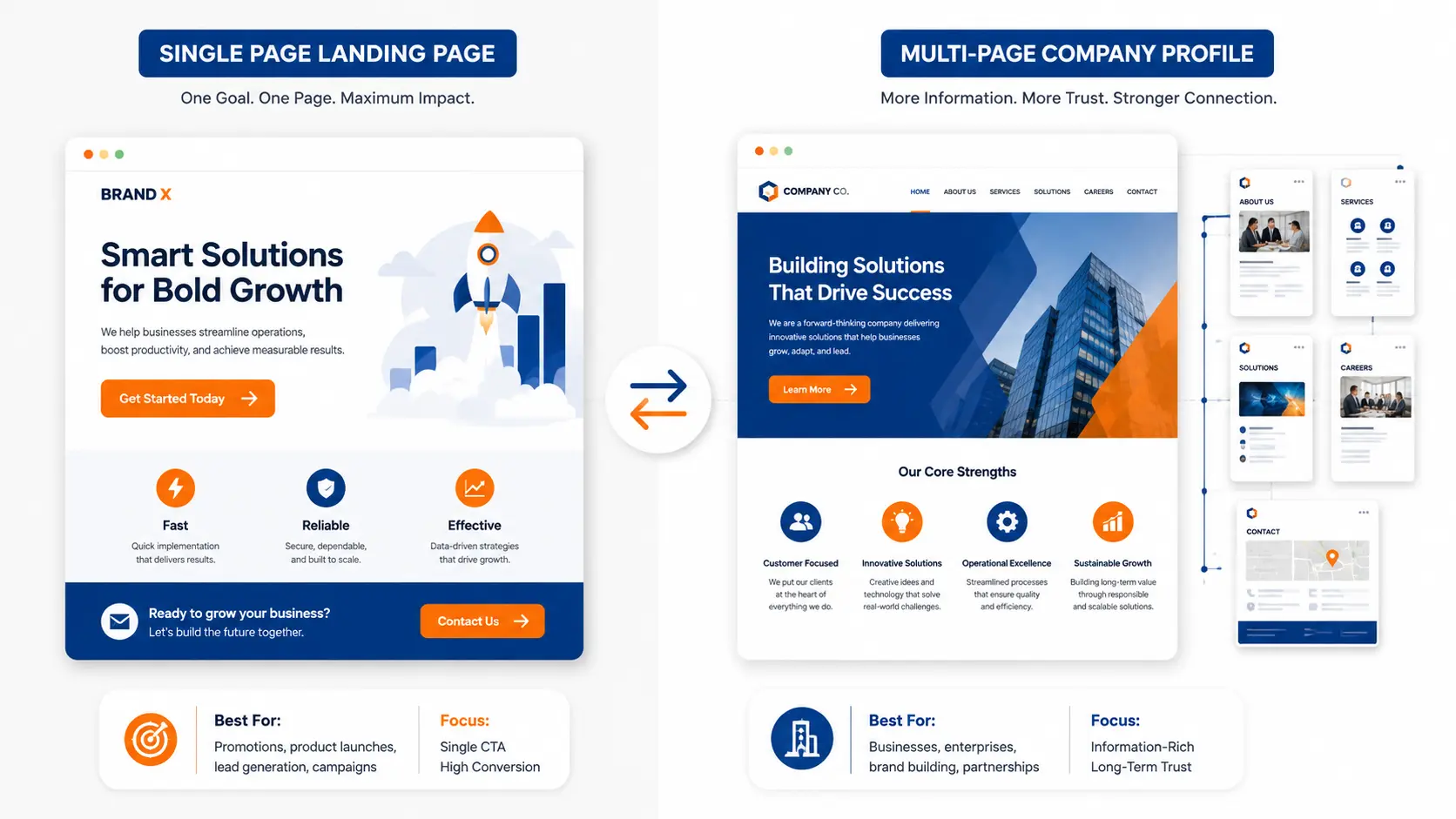
A landing page is a single, focused web page designed for one specific conversion goal. There is no navigation menu to distract visitors, no links leading elsewhere — just one clear message and one Call to Action (CTA).
Common landing page goals include:
Getting visitors to sign up for a webinar
Collecting leads for a new product launch
Selling a specific service package
Directing paid ad traffic to a single offer
This single-minded focus is precisely what makes landing pages such a powerful tool in digital marketing campaigns.
What Is a Multi-Page Website?
A multi-page website — often referred to as a company profile or corporate website — is a structured site consisting of multiple interconnected pages: Home, About Us, Services, Portfolio, Blog, and Contact. Visitors are free to browse and explore information at their own pace.
Its purpose is broader: building brand credibility, communicating the full picture of your business, and serving multiple visitor segments simultaneously — from prospects who are just discovering you to partners who want to review your portfolio.
What the Data Says: How Effective Are Landing Pages?
One of the strongest arguments for using a landing page in a specific campaign is its consistently strong conversion performance. Based on Unbounce's analysis of 41,000 landing pages with 464 million visitors, the median conversion rate across all industries stands at 6.6% (Q4 2024).
This figure significantly outperforms the average conversion rate of a typical website page. Top performers in certain sectors push well beyond 10%, while financial services leads all industries with a median of 8.4%.
Other key findings from the data:
Every additional second of page load time cuts conversions by up to 7%
Personalized CTAs outperform generic ones by 202%
Forms with 5 or fewer fields generate double the conversions of longer forms
These numbers are not coincidental — they are the direct result of design that relentlessly focuses on a single outcome.
When Should You Choose a Landing Page?
A landing page is the right choice when:
1. You are running paid advertising (Google Ads, Meta Ads, TikTok Ads)Sending ad traffic to your homepage is one of the most common (and costly) mistakes in digital marketing. A landing page with strong message match to your ad copy consistently delivers higher conversions and a better return on ad spend.
2. You are launching a single product or specific serviceIf you are selling one design package, one online course, or one physical product, a landing page forces visitors to focus entirely on that offer without distraction.
3. You are running a time-limited promotion or eventSeasonal sales, early bird offers, or flash promotions need dedicated pages that create urgency. Landing pages can be built quickly, measured independently, and updated without touching your main website.
4. You need precise campaign measurementWith a separate landing page for each campaign, you can accurately track which ad drove leads, what the cost per conversion is, and exactly what needs to be optimized next.
When Should You Choose a Multi-Page Website?
A multi-page website is the better fit when:
1. You want to build long-term credibilityProspective clients — especially in B2B — almost always research a business before reaching out. They want to know who your team is, what services you offer, and what past projects look like. Answering all of that requires more than a single page.
2. Your business offers multiple products or servicesDigital agencies, law firms, healthcare clinics — businesses like these serve diverse audiences with different needs. A multi-page website gives you the space to explain each service in depth and speak to each audience segment appropriately.
3. You want to rank organically on search engines (SEO)Every page of a multi-page website is an opportunity to appear in Google search results. Blog posts, individual service pages, and FAQ sections can each target different keywords and drive long-term organic traffic — something a single landing page simply cannot achieve.
4. You need a central digital hub for your businessA multi-page website serves as the official "digital headquarters" of your business — the place you reference in business cards, email signatures, proposals, and social media profiles.
The Ideal Setup: Combine Both
The good news is that you do not have to make a permanent choice between the two. The strategy used by many growing businesses is to combine a main website with dedicated landing pages for each campaign.
A practical example:
Main website (multi-page): Official business profile, SEO-focused, long-term brand building.
Campaign landing page A: Exclusively for a Google Ads campaign promoting a current quarterly package.
Campaign landing page B: A lead magnet (e.g., a free ebook) distributed via Instagram Stories.
With this approach, you get the long-term advantages of SEO and brand authority, while still achieving high conversion rates from every marketing campaign you run.
Quick Comparison
Aspect | Landing Page | Multi-Page Website |
|---|---|---|
Primary goal | Specific conversion | Branding & comprehensive information |
Number of pages | 1 | 5–20+ |
Average conversion | ~6.6% (median) | Varies, generally lower |
Best for | Ads, promotions, single products | Company profile, multiple services |
Long-term SEO | Limited | Very strong |
Build time | Faster | Longer |
Final Thoughts
There is no one-size-fits-all answer here. If you are just getting started and working within a limited budget, a well-structured multi-page website is more than enough to establish a credible digital presence. Add landing pages when you begin running paid campaigns or specific promotions.
The most important thing: do not let technical confusion delay your online presence. Work with an experienced team to match your website investment to your actual business goals — and make every rupiah count.
References
Genesys Growth — Landing Page Conversion Rates: 40 Statistics Every Marketing Leader Should Know
Landingi — Landing Page Conversion Rate: What Is a Good One?
LanderLab — 10 Landing Page Optimization Practices for 2024
Unbounce Conversion Benchmark Report (via Genesys Growth, Q4 2024)