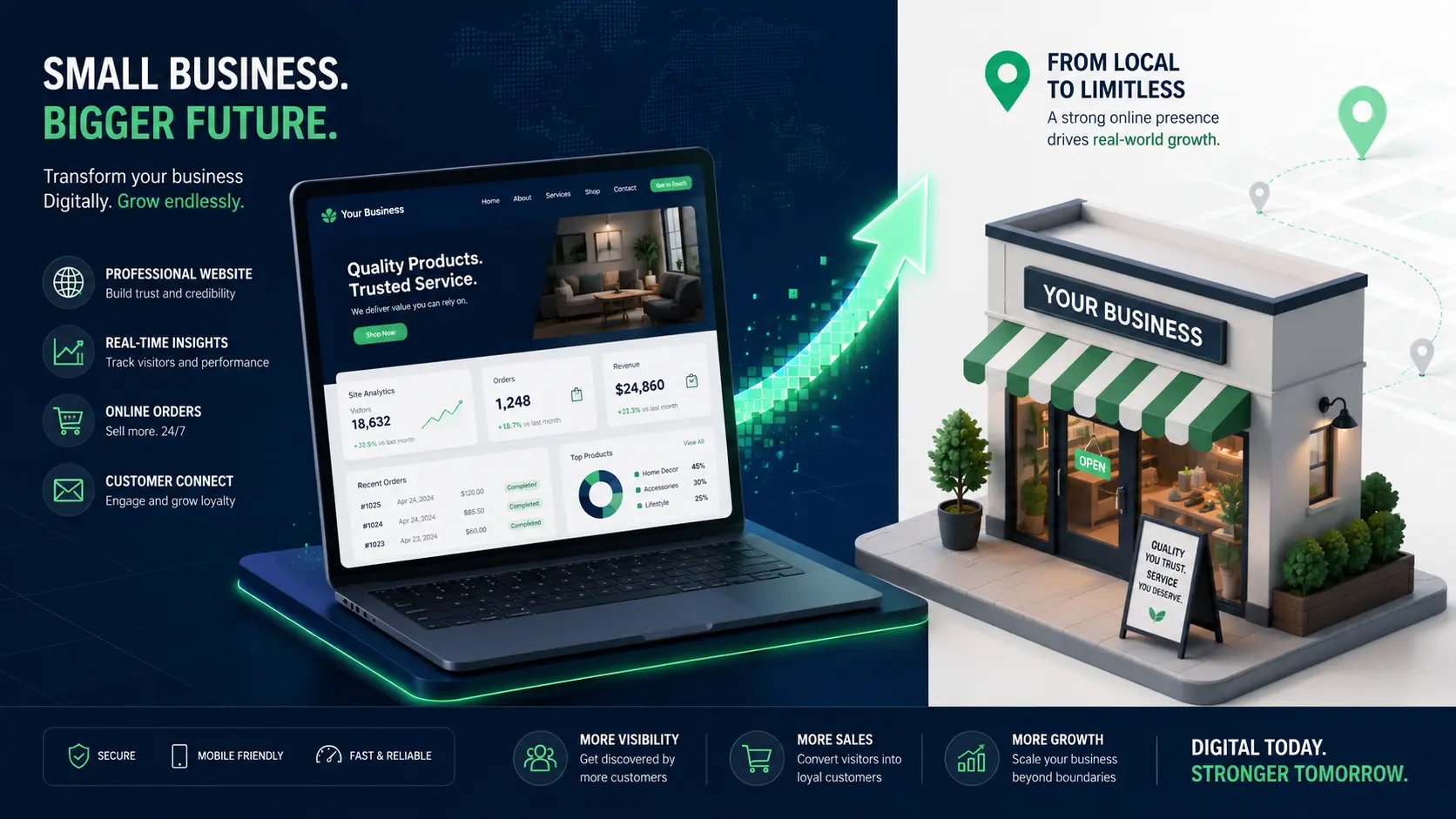
AI Is No Longer Just for Big Corporations
Not long ago, artificial intelligence was synonymous with tech giants — Google, Amazon, Microsoft — entities with thousands of engineers and billion-dollar computing infrastructure. That landscape has fundamentally shifted.
Gartner describes AI democratization as "one of the most disruptive trends of this decade." With platforms like ChatGPT, Gemini, and a growing ecosystem of API-based AI services, small businesses can now leverage the same technology that once required enormous capital investment — no deep technical expertise required.
The numbers from JP Morgan Chase Institute make this concrete: the 2025 small business cohort reached a 10% AI adoption rate in just six months, compared to the 2019 cohort which took over six years to reach the same milestone. That means today's AI adoption is happening 13 times faster than before.
What Does AI Actually Do for Small Businesses?
Surveys of small business owners who have implemented AI reveal tangible, measurable impact:
82% reported improved operational efficiency
77% felt more competitive against larger companies
69% maintained growth even under challenging market conditions
McKinsey projects the long-term productivity potential of AI at $4.4 trillion from corporate use cases alone. At the individual level, their research identifies approximately one hour of daily work activities that could be automated today — a figure projected to rise to three hours per day by 2030.
Saikat Chaudhuri, Faculty Director of the Entrepreneurship Hub at UC Berkeley's Haas School of Business, notes that AI now enables aspiring entrepreneurs to start a business "with no prior expertise required" — from building a basic website to drafting a full business plan.
Academic validation comes from a hybrid literature review published in Review of Managerial Science (Springer Nature, 2025) that analyzed 345 peer-reviewed articles. Its conclusion: AI democratization enables entrepreneurs to compete with large corporations, leveling a technological playing field that has long been tilted in favor of the well-resourced. The Journal of Innovation and Entrepreneurship (Springer, 2025) further demonstrates that AI access via cloud platforms and APIs allows business owners to leverage advanced technology with significantly lower upfront investment — particularly impactful in knowledge-based industries.
But There's a Critical Problem: Your Data Isn't Yours
Here lies a paradox that too many small business owners overlook. As AI becomes more accessible, many SMEs are building their businesses on land they don't own — selling on marketplaces, relying on social media as their primary marketing channel, without ever establishing their own digital home.
Research from Berkeley's BRIE introduced the term "platform-dependent entrepreneurship" — a condition where a business's economic and strategic agency is entirely subject to the decisions of the platform on which it operates. Platforms control algorithms, data, monetization rules, and access terms. And they can change any of these unilaterally, at any moment.
The Management journal (MDPI, 2024), reviewing 48 interdisciplinary studies, found that platforms systematically apply control mechanisms over sellers through algorithmic systems — creating a genuine power asymmetry between platforms and the businesses that depend on them.
Consider this scenario: You've spent three years building a following of thousands on Instagram. One day, the algorithm shifts and your organic reach drops by 80%. Or worse — your account gets suspended without a clear explanation. Everything you built, every piece of customer data that should have been yours, disappears.
Your Own Website = A Data Asset No One Can Take Away
First-party data — data collected directly from customer interactions on your own platform — is a business asset that is uniquely yours and unmatched in value. This isn't just a trend; it's a strategic imperative.
The evidence is in real numbers. W for Woman, India's largest fashion e-commerce brand, adopted a first-party data strategy in 2019 and recorded:
20% incremental revenue growth
4x higher conversion rates compared to new customers
Results that far exceeded Google's own projection of just 11% improvement
Gartner warns that by 2025, 75% of marketing programs relying on third-party customer data will generate less incremental revenue than the cost of collecting and managing that data. Only 25% will truly outperform — those with a strong first-party data strategy already in place.
Research published in PLOS ONE (2023, Shanghai University of Finance and Economics) confirms: the ability to analyze and apply large datasets is the primary differentiating factor in modern digital platform competition.
How AI + Your Own Website Creates Competitive Advantage
This is the combination that's genuinely powerful for SMEs today:
1. AI automates the routineChatbots handle customer inquiries around the clock. Marketing content is generated faster. Sales data analysis no longer requires a dedicated data analyst. The time saved can be redirected toward what truly requires human judgment and creativity.
2. Your website becomes your data hubEvery visit, every click, every form submission — this is data that belongs entirely to you. No platform can revoke it. With this data, your AI tools work better: more relevant personalization, sharper recommendations, and more accurate business decisions.
3. Independence from algorithmic changesWhen a marketplace changes its fee structure, or a social platform shifts its algorithm, businesses with their own website have a stable foundation. Organic traffic built on your own site through SEO is far more sustainable than rented reach on someone else's platform.
4. Greater credibility and trustConsumer surveys consistently show that businesses with professional websites are perceived as more trustworthy. In an era where anyone can sell online, a well-built website remains a meaningful differentiator.
Getting Started Doesn't Have to Be Expensive or Complex
One of the biggest barriers for SMEs is the perception that having their own website requires significant investment and technical expertise. The reality in 2025 is that these barriers are lower than they have ever been.
Affordable hosting services, ready-to-use website templates, and AI that can assist with content creation — all of this is available now. What's needed is the first step: a commitment to owning your own digital asset.
Entrepreneurship Theory and Practice (SAGE Publications, 2025) describes the democratization of entrepreneurship in the AI era as "one of the most exciting and evolving frontiers in entrepreneurial research." The opportunity is real — and it's open to anyone willing to take it.
Conclusion
AI has leveled the playing field. Technology once reserved for large corporations is now in the hands of every entrepreneur. But maximizing what AI can do for your business requires a strong foundation: data that belongs to you — data that can only be truly yours if you own your own website.
Don't build your business on someone else's land. Invest in your digital asset. A professional website is the single most strategic first step you can take today.
References
JP Morgan Chase Institute (2025). Small Business AI Adoption Report.
McKinsey & Company (2025). The Economic Potential of Generative AI.
Gartner. Top Strategic Technology Trends: AI Democratization.
Springer Nature (2025). Review of Managerial Science — Hybrid literature review on AI & Entrepreneurship (345 articles).
Springer (2025). Journal of Innovation and Entrepreneurship — AI access via cloud & API.
SAGE Publications (2025). Entrepreneurship Theory and Practice — Democratization of Entrepreneurship.
MDPI (2024). Management Journal — Platform dependency review (48 studies).
PLOS ONE (2023). Shanghai University of Finance and Economics — Data-driven services in platform competition.