Sovereign AI: Between Announcements and Capacity You Can Rent
Over the past year, "sovereign AI" has appeared in nearly every major technology announcement in Indonesia: hundred-megawatt data center campuses, a national AI roadmap, an AI fund managed by Danantara, and a new law on data. For business owners and CTOs, the real question is much simpler: what can I actually rent and use inside the country today, and what only becomes available from 2027?
This article separates the two. It does not revisit the mechanics of calling models across regions (covered in Host in Jakarta, Call Models Cross-Region) or the self-hosting vs API math (see Self-Host LLM vs API Provider). Instead, it maps domestic AI infrastructure availability along a timeline.
Capacity Today vs Policy Targets
The most important number to start with: according to Coordinating Economic Minister Airlangga Hartarto (quoted by The Jakarta Post, July 2026), Indonesia has around 580 MW of operational data center capacity, with a further pipeline of about 1.3 GW representing USD 15–20 billion of investment.
On the other side sits a stated policy ambition: 1.65 GW of national data center capacity by the end of 2026 (Tech for Good Institute, 2026). To be clear, this is a stated target from a single source, not a projection you should build capacity plans on. With 580 MW operating in mid-2026, the gap to that target exceeds 1 GW, and most of the projects that could close it are only scheduled to enter service from 2027.
| Indicator | Status | Source |
|---|---|---|
| Operational data center capacity | ~580 MW (July 2026) | Airlangga Hartarto via The Jakarta Post |
| Capacity pipeline | ~1.3 GW (USD 15–20 billion) | Airlangga Hartarto via The Jakarta Post |
| National target for end-2026 | 1.65 GW (policy ambition) | Tech for Good Institute |
| National AI Roadmap 2026–2029 | Still a draft presidential regulation | Reuters, June 2026 |
| Sovereign AI fund (Danantara) | Proposed, no deployment details | Reuters, June 2026 |
The practical lesson: do not write a business plan that assumes policy targets arrive on time. Plan around capacity you can already contract.
The Big Projects Are Still Breaking Ground
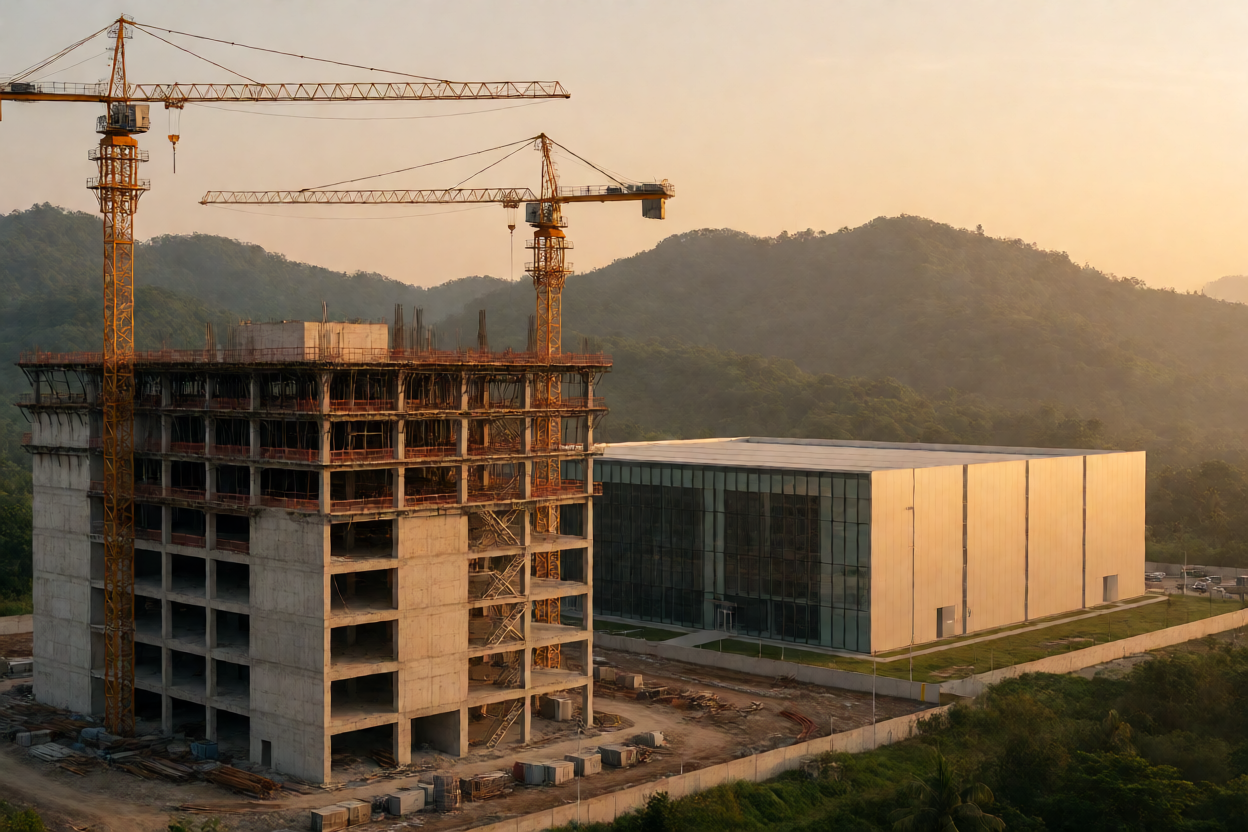
The two projects most often cited as proof of a domestic AI boom are not serving customers yet:
BDx AI Campus 2 (CGK4), Jatiluhur, West Java. The groundbreaking was announced on September 22, 2026. The campus is planned at 640 MW across six buildings, backed by 845 MVA of grid power from PLN, with direct-to-chip liquid cooling designed for up to 500 kW per rack. Building 1 will deliver 120 MW in phases, and its first contracted phase is expected to enter service in early 2027. The full campus is expected to take about three years, with buildings commissioned sequentially.
The Firmus/DayOne campus in Batam. This 360 MW campus is phased from Q1 2027 through 2028, with plans for up to 170,000 Nvidia GPUs through Nvidia's DSX revenue-sharing programme (Bloomberg, June 2026).
Both are real projects with secured financing and power, but their status is construction, not service. Hundreds of megawatts of domestic GPU capacity for training large models can realistically be ordered from 2027 onward, and even then only in phases.
Domestic GPU Options You Can Use Now
So what is available today?
- GPU Merdeka by Lintasarta (Indosat group). A sovereign AI cloud running on Nvidia hardware, launched in 2024. Its GPU count is not published, so for large requirements you need to ask about availability directly.
- Hyperscale cloud regions in Indonesia. Microsoft opened its first hyperscale cloud region in Indonesia in November 2025 as part of a USD 1.7 billion commitment. That covers data residency for general applications; GPU and specific AI model availability in that region has to be checked per service.
- Local models you can host yourself. GoTo and Indosat's Sahabat-AI has reached a 70-billion-parameter version (June 2025), and its 8B and 9B versions have been downloaded more than 35,000 times on Hugging Face. Models of this size are realistic to run on rented domestic GPUs.
Which workloads fit these options today?
| Workload | Realistic in-country today? |
|---|---|
| Inference on small to mid-size models (7B–70B) for sensitive data | Yes, on rented domestic GPUs |
| Light fine-tuning (LoRA) of open-weight models | Yes, at limited scale |
| RAG over internal documents that must stay in Indonesia | Yes |
| Large-scale foundation model training | Not yet; wait for the 2027+ campuses |
| Access to closed frontier models (GPT/Claude/Gemini class) | Mostly still cross-region |
The One Data Indonesia Law: Data Sovereignty Written into Law
On October 6, 2026, the House of Representatives (DPR) passed the One Data Indonesia (Satu Data Indonesia) bill in a plenary session. It has not been promulgated yet, so it has no law number. It spans 20 chapters and 141 articles. The points relevant to AI infrastructure:
- One Data infrastructure and its risk management cover the use of digital technology, blockchain and AI, which must still guarantee national data sovereignty, traceability and human oversight.
- Access to and transfer of closed data outside Indonesian jurisdiction requires DPR approval.
- A data sovereignty audit becomes part of the data security standard.
- Security incidents must be reported within 1 x 24 hours.
- Attacking, sabotaging or taking over national data centers and One Data infrastructure carries up to 15 years in prison (Article 133), and corporations can also be held criminally liable (Article 135).
Its main scope is government data and the data producers and custodians in the One Data ecosystem. Specific obligations for the private sector have not been detailed in reporting, and implementing regulations are not out yet. But the direction is clear: if your business processes data that comes from or links to government data, sending it to a model abroad will become harder to justify.
When to Wait, When to Go Hybrid
Waiting for 2027 makes sense if:
- You plan to train or heavily fine-tune large models and need hundreds of GPUs in-country.
- Your project is bound by rules that require the entire AI pipeline to sit in Indonesia, and you have no production deadline before 2027.
Moving now with a hybrid architecture makes sense if:
- You need results within months. Split data by classification: sensitive data and anything tied to government data goes to open-weight models on domestic GPUs, while general tasks with no personal data can use cross-region frontier model APIs.
- Your application and database already live in Jakarta; only the inference layer needs to be portable. Wrap model calls behind a single internal gateway, so when 2027 capacity arrives you only swap the endpoint.
- Start preparing what regulation will ask for: access logs, data classification, a 1 x 24 hour incident reporting procedure, and a record of where each piece of data is sent.
Conclusion
Indonesian sovereign AI today is a mix of real but limited capacity (around 580 MW of data centers, GPU Merdeka, local cloud regions, models such as Sahabat-AI) and large ambitions that only start materialising from 2027. The safest strategy is not to wait for everything to be ready, but to build an architecture that can move workloads in-country step by step, as capacity actually enters service.